
Enterprise LLM Gateway
Solving LLM lock-in, governance, and cost control for modern enterprises. Why a governance-first control plane — not another multi-provider router — is what organisations need when commercial models, private LLMs, and internal RAG all have to coexist under one policy.
In 2026, large language models have become essential infrastructure for knowledge work. Yet most enterprises find themselves stuck.
They adopt one or two leading models — Claude, Grok, GPT, Gemini — and then discover how difficult it is to change. Security reviews, data residency rules, prompt libraries, user training, and contractual commitments create powerful lock-in. Meanwhile, model capabilities, pricing, and performance shift every few weeks. What looked like a smart long-term choice quickly becomes a strategic risk.
At the same time, employees want flexibility. Power users want the best model for each task. Security and compliance teams want strong controls. Finance wants predictable costs and visibility. IT wants a single, manageable system.
These conflicting needs are exactly what the Enterprise LLM Gateway is designed to solve.
The core problem
Today’s reality for most organisations looks like this:
- Teams are locked into one or two commercial LLM providers.
- Switching costs are high and slow.
- There is little central visibility into how AI is actually being used.
- Sensitive corporate data can easily leave the organisation through uncontrolled prompts.
- Cost control is reactive rather than proactive.
- Internal knowledge (RAG systems and privately hosted models) sits in a separate silo from commercial LLMs.
Public multi-provider gateways help individual developers, but they were not built for enterprise governance, data protection, or internal system integration.
Introducing the Enterprise LLM Gateway
The Enterprise LLM Gateway is a governance-first control plane that sits between employees and every LLM resource the organisation uses — commercial APIs, privately hosted open-source models, and internal RAG engines.
It becomes the single entry point for all LLM work.
Key principles
- Policy over preference — Corporate rules come first, with controlled flexibility for power users.
- Strong data protection — Sensitive information is blocked or redacted before it ever leaves the corporate trust boundary.
- True multi-source routing — Commercial models, internal models, and internal RAG are treated as equal citizens.
- Visibility without surveillance — Usage is measured in a privacy-respecting way.
- Minimal friction — Users should barely notice the Gateway is there.
High-level architecture
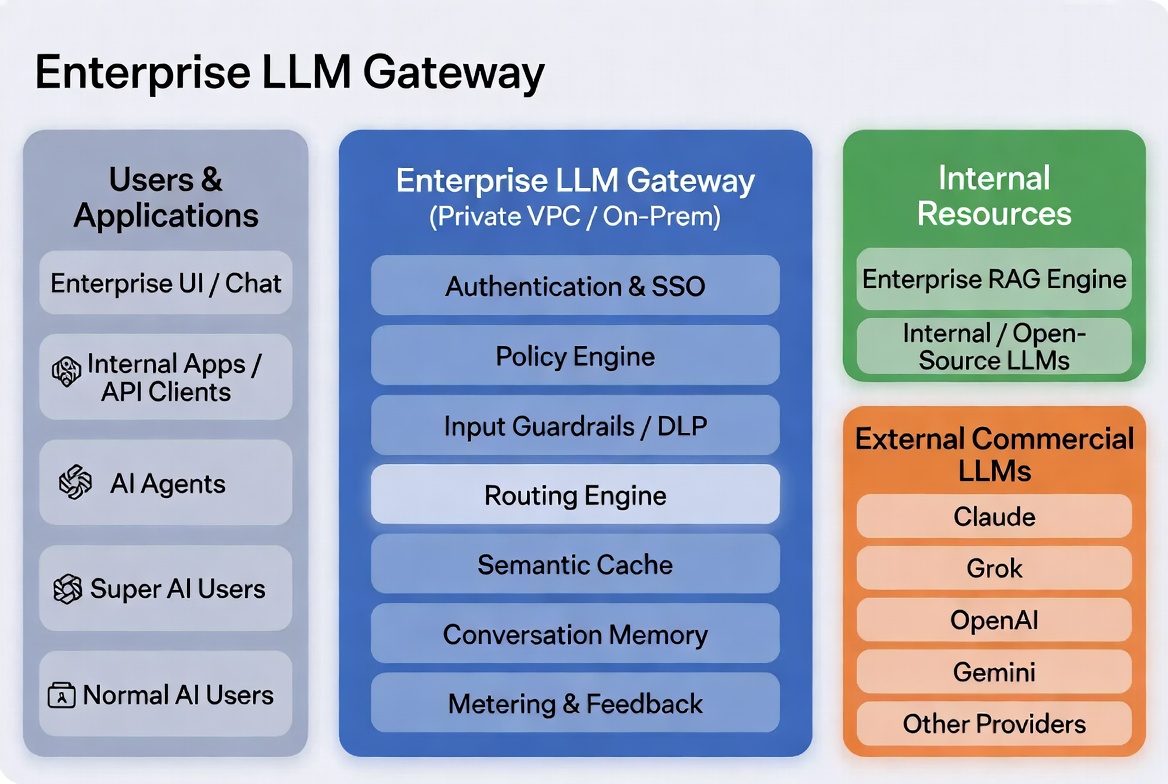
Key architectural decisions
| Concern | Approach |
|---|---|
| Deployment | Preferred: customer’s private VPC or on-premises. Cloud-hosted private instance also supported. |
| API keys | Small number of enterprise-grade keys per provider, managed centrally by the Gateway. |
| Conversation memory | Managed per-user and per-conversation with strict isolation. |
| Data isolation | No user can ever see another user’s prompts, responses, or detailed activity. |
| Latency | Target added overhead well under 30 ms with full streaming support. |
| Limits | Same token/rate/model limits apply to UI and API (based on identity + purpose + role). |
Key capabilities
- Single entry point for all LLM traffic (commercial + internal + RAG)
- Purpose-based routing defined by corporate administrators
- Role-based access: Normal AI Users follow policy; Super AI Users can override within clear limits
- Strong input guardrails / DLP before any data leaves the organisation
- Semantic cache to reduce cost and latency
- Conversation memory managed per user and per thread with strict isolation
- 1–5 star feedback so the organisation can learn which combinations work best
- Privacy-respecting analytics: token usage by user, department, and category of work
- Same limits for UI and API
- Enterprise API key management
How it differs from typical public gateways
| Capability | Typical public gateway | Enterprise LLM Gateway |
|---|---|---|
| Multi-LLM routing | Yes | Yes |
| Cost / latency optimisation | Strong focus | Secondary |
| Corporate policy engine | Weak or absent | Core capability |
| Purpose → model mapping | Rare | Explicit (admin-defined) |
| Normal vs Super AI User roles | Rare | Explicit |
| Strong input guardrails / DLP | Usually weak | Critical requirement |
| Routing to internal RAG / internal LLMs | Rare | First-class |
| Semantic cache | Sometimes | Required |
| Privacy-respecting metering | Limited | Explicit goal |
| Preferred deployment | Multi-tenant public | Private VPC / corporate firewall first |
| User feedback (1–5 stars) | Rare | Supported and fed into analytics |
Benefits for the organisation
- Reduced vendor lock-in and faster adoption of new models
- Stronger protection of corporate intellectual property and sensitive data
- Clear visibility into AI usage and cost drivers
- Better matching of model to task (higher quality + lower cost)
- A single, governed path for both human users and internal applications
- Ability to keep more queries inside the organisation via internal RAG and private models
Conclusion
The Enterprise LLM Gateway is not just another multi-provider router. It is a control plane designed for the realities of enterprise AI adoption in 2026 and beyond: rapid model change, rising data sensitivity, the need for cost discipline, and the growing importance of internal knowledge systems.
By making the Gateway the single, policy-driven entry point, organisations can finally treat LLMs as manageable infrastructure rather than a collection of unmanaged point solutions.